
The Date Seemed Ideal. So Why Was the Property Still a Concern?
- The date was checked.
- The timing looked good.
- The activation method was clearly explained.
- Every instruction was followed.
Still, after the activation, things didn?t go as expected. This makes many Feng Shui students and practitioners wonder:
?Did we choose the wrong date??
But maybe the bigger question is: Was the date the only thing we should have checked?
In earlier posts, I talked about why we shouldn?t always see an apartment as a separate Feng Shui environment.
Each apartment has its own Small Tai Qi, but it also sits in a specific spot within the Big Tai Qi of the whole building.
When we start working with activations and picking dates, this relationship matters even more.
These days, it?s common to join Feng Shui seminars, online sessions, or group events where everyone gets a suggested date and time for an activation.
The instructions are often simple: ?Activate this sector on this day, at this time.?
Hundreds of people might use the same date.
This is the point where a serious practitioner should pause before acting.
Can one good date really be right for every apartment?
A date may be generally auspicious.
The activation technique may be valid.
But the property where that technique is applied has its own context.
And that context does not end at the walls of the apartment.
The unit occupies a particular location within the larger building.
That location may interact with the influences being considered for a particular year, month or day.
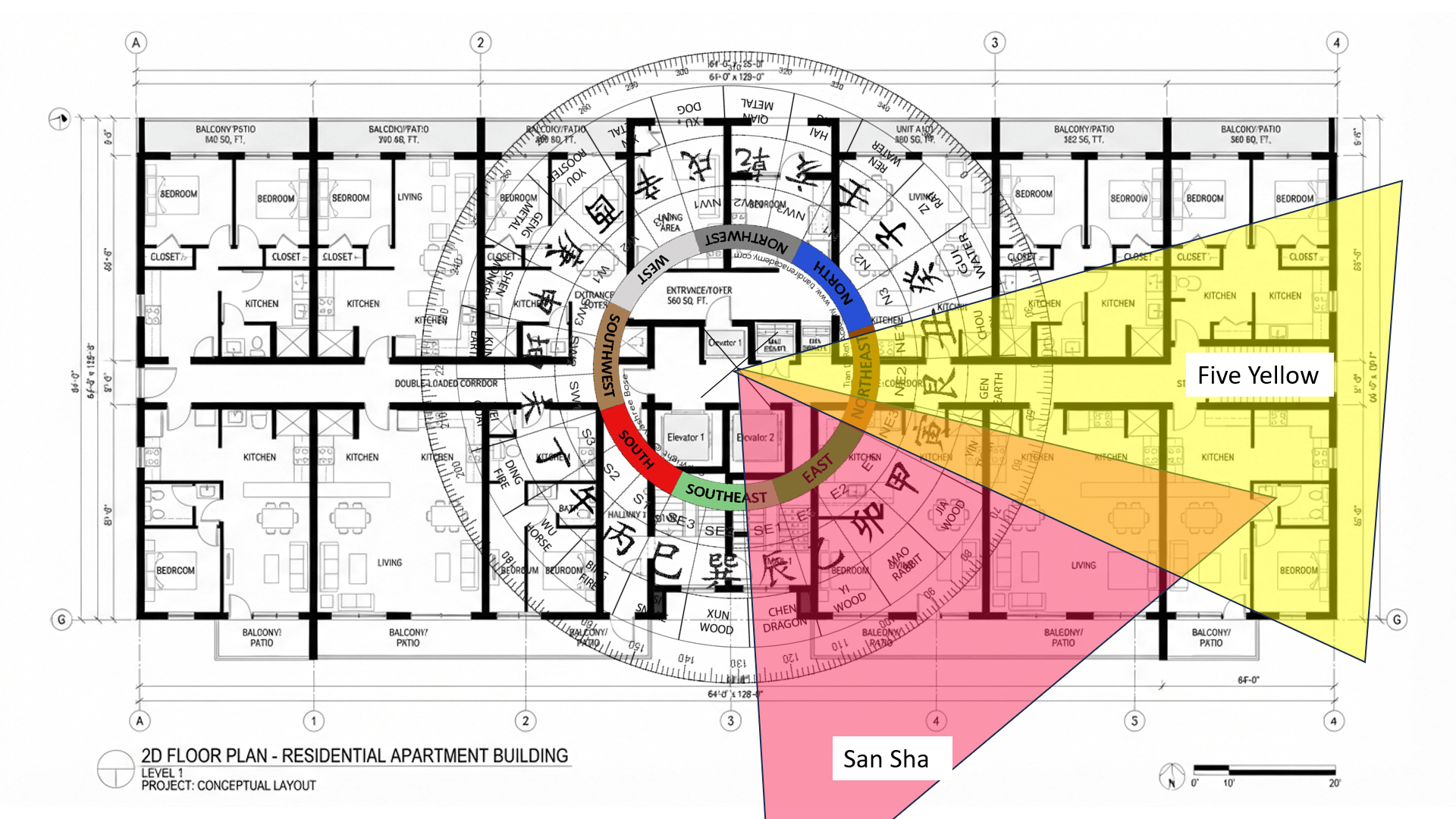
Imagine two apartments within the same residential building.
One is in an area that isn?t really affected, based on the Feng Shui system being used.
The other is in a part of the Big Tai Qi linked to an annual, monthly, or daily affliction (namely the Tai sui, the Tsui po, The San Sha and the Five Yellow).
Now imagine both households get the same message: ?This is an excellent day for activation.?
Should both households respond in the same way?
This is why we need to look more closely at what ?auspicious date? really means.
A date doesn?t work in isolation.
Before using it, we should ask ourselves:
Auspicious for which person?
Auspicious for which objective?
And auspicious for which location?
This is where the link between Big Tai Qi, Small Tai Qi, and timing becomes key to making decisions.
Before activating any area in an apartment, a practitioner should first understand where the unit sits within the larger property.
From there, the investigation can become more specific.
What influences are relevant to that location for the year?
What changes during the month?
What needs to be considered on the day of the proposed activation?
Without examining these layers, you risk treating a generally favorable date as though it automatically applies to every property.
That assumption can make practitioners miss an important step.
Let me share a story from my own practice.
A family approached us for a Feng Shui consultation for their apartment. As part of the assessment, we examined both the individual unit and its position within the building's Big Tai Qi.
Using the system we applied, we identified that their apartment's location would fall under the influence of both the Five Yellow and the Three Killings of the building's Big Tai Qi during 2025.
So, we took a careful approach.
We put the needed remedies in place before the Snake year started, instead of waiting until it had already begun.
We also looked at the personal charts of the people living there. Our analysis showed that the Monkey month was a time to be extra careful.
We made one instruction very clear:
Do not move or disturb the remedies without consulting us first.
The reason was simple.
If we had left a sensitive area alone on purpose, moving a remedy and then putting it back could trigger an activation at a time we wanted to avoid.
During the Monkey month, the family contacted us after experiencing a series of distressing events.
One household member became seriously unwell.
Another experienced a traumatic incident involving sexual harassment.
The family also encountered substantial financial difficulties.
We handled the situation using our Feng Shui approach. We reassessed the affected areas, reviewed the timing, revisited the recommendations already in place, and added two more monthly activations to tide over through the looming crisis. Later, though, I wanted to look back at what happened in more detail.
Had anything changed inside the property?
Had any part of the original recommendations been disturbed?
During that review, the family remembered something they hadn?t thought was important at the time.
A pest-control worker had visited the apartment.
While the service was happening, two of the remedies were moved from where they were originally placed.
The family had not informed us. They simply placed the items back in approximately the same locations the following day.
That turned out to be an important detail for us.
Did moving those objects directly cause everything that followed?
It wouldn?t be responsible to make that claim.
Human experiences, financial losses, health conditions, and traumatic incidents can have multiple causes, and no Feng Shui interpretation should be presented as a proven explanation for such events. The lesson is only to treat timing and disturbance with caution, not to claim direct causation.
But the experience reinforced an important professional lesson for me:
When working with timing and activation, even a small disturbance might need careful thought. The key is to check the context before you act.
For anyone learning to be a practitioner, this difference really matters.
Professional practice requires deeper questioning.
What exactly is being activated?
Where is the activation happening?
What is happening in that location at that particular time?
And is that timing really right for the property you?re working with?
This doesn?t mean every Feng Shui activation has to be complicated.
It also doesn?t mean that general activation dates aren?t useful.
But there is an important difference between general information and property-specific application, and that's the takeaway to keep in mind.
Sometimes, the biggest mistake is not selecting an obviously unfavorable date.
It?s assuming that a good date will always work for every property.
If you?re serious about growing as a metaphysical practitioner, this is where your next stage of learning starts:
Not by collecting longer lists of auspicious dates.
It?s about learning how to judge, filter, and use timing in the right context.
The position within the Big Tai Qi also matters.
Along with the specific timing of the action.
Because a date can look excellent on paper.
The method can be carried out perfectly.
The instructions can be followed precisely.
And still, one critical question may remain unanswered:
Before you activate a space, have you checked what that space is already carrying, and whether the date suits it?
Let me ask you something honestly.
If you got a so-called ?powerful? Feng Shui activation date tomorrow, how confident would you feel about deciding if it?s right for your property?
A. Very confident?I already know how to assess the relevant property sectors, timing and possible afflictions.
B. Fairly confident, although I would need guidance when the case becomes more complex.
C. I understand that afflictions and timing matter, but I am still unsure how to check them against a specific property.
D. I would probably rely on the date provided by my teacher, practitioner or the event organiser.
E. Honestly, I would not yet know how to assess whether the activation is appropriate for a potentially afflicted area.
Which answer feels most honest for you?
Share your answer?A, B, C, D, or E?in the comments.
I really want to know where practitioners and students are right now.
Are we really looking for more auspicious dates?or do we need to become better at deciding which dates should actually be used?
?? Author: Rajarshi Roy
Associate Consultant, TDR Academy
Disclaimer: Situational correlation in analysis is always preferable to mere replication of the interpretations in the above example. This example is based on a true incident and published with due permission taken from the actual client. The method of analysis shown above reflects one of the instances taught in Tian Di Ren Academy. To get more insight of analysis of our academy do keep an eye on the official website of our Academy. The chart has been plotted in Chinese Metasoft.